Current Projects
What Matters Most? Advancing Patient-Centered Abortion Care in Canada
Abortion care varies widely across Canada and the needs of abortion seekers from underserved populations are largely unmet. In this study, we seek to investigate what matters most to people in Canada when considering accessing abortion services, and to identify the specific decisions and decision-making needs of people seeking abortion.
Funded by Canadian Institutes of Health Research Project Grant → Participate in the study!The CART-Access Project: Advancing Access to Abortion for Underserved Populations Through Tools for Healthcare Professionals and People Seeking Care
A key problem in advancing access to abortion care is the lack of resources for healthcare professionals to identify and utilize appropriate approaches and strategies to facilitate equitable access. This multi-year project by the Canada-wide Contraception & Abortion Research Team (CART) aims to address this gap. Within this larger team, the Lawless Lab has been conducting research and developing resources to advance care for those with experience of incarceration.
Funded by Health Canada Sexual and Reproductive Health FundRead more about our CART projects
The Abortion Doula Project
This project examined the role of abortion doulas, their collaboration with abortion health professionals, and their presence across Canada.
Findings
- Paynter, M., Heggie, C., McLeod, A., Castonguay, M., Fuller, M., Norman, W. (2025) — The role of doulas in abortion care in Canada: A qualitative study. PLOS ONE. Full PDF →
The Family Planning for People in Prison Project
This project examined access to abortion and contraception for people in prison. The project investigated the experiences of health professionals providing family planning care and the experiences of frontline service personnel supporting formerly incarcerated people seeking care.
Findings
- Paynter, M., Heggie, C., McLeod, A., Norman, W. (2026) — Frontline social service workers' experiences supporting sexual and reproductive health of people who have been incarcerated. Journal of Health Care for the Poor and Underserved. In Press.
- Paynter, M., Heggie, C., McLeod, A., Norman, W. (2025) — The experiences of family planning health professionals providing care to incarcerated patients: A qualitative study. BMC Pregnancy and Childbirth. Full PDF →
- Paynter, M., Heggie, C., McLeod, A., Norman, W. (2025) — A Qualitative Study of Abortion Professionals' Perspectives on Doula Support. PLOS ONE. Full PDF →
The Correctional Officers (CO) Engagement Project
This project investigated CO roles in access to family planning information and services for incarcerated people. We developed resources to address information gaps and to support patient confidentiality and dignity.
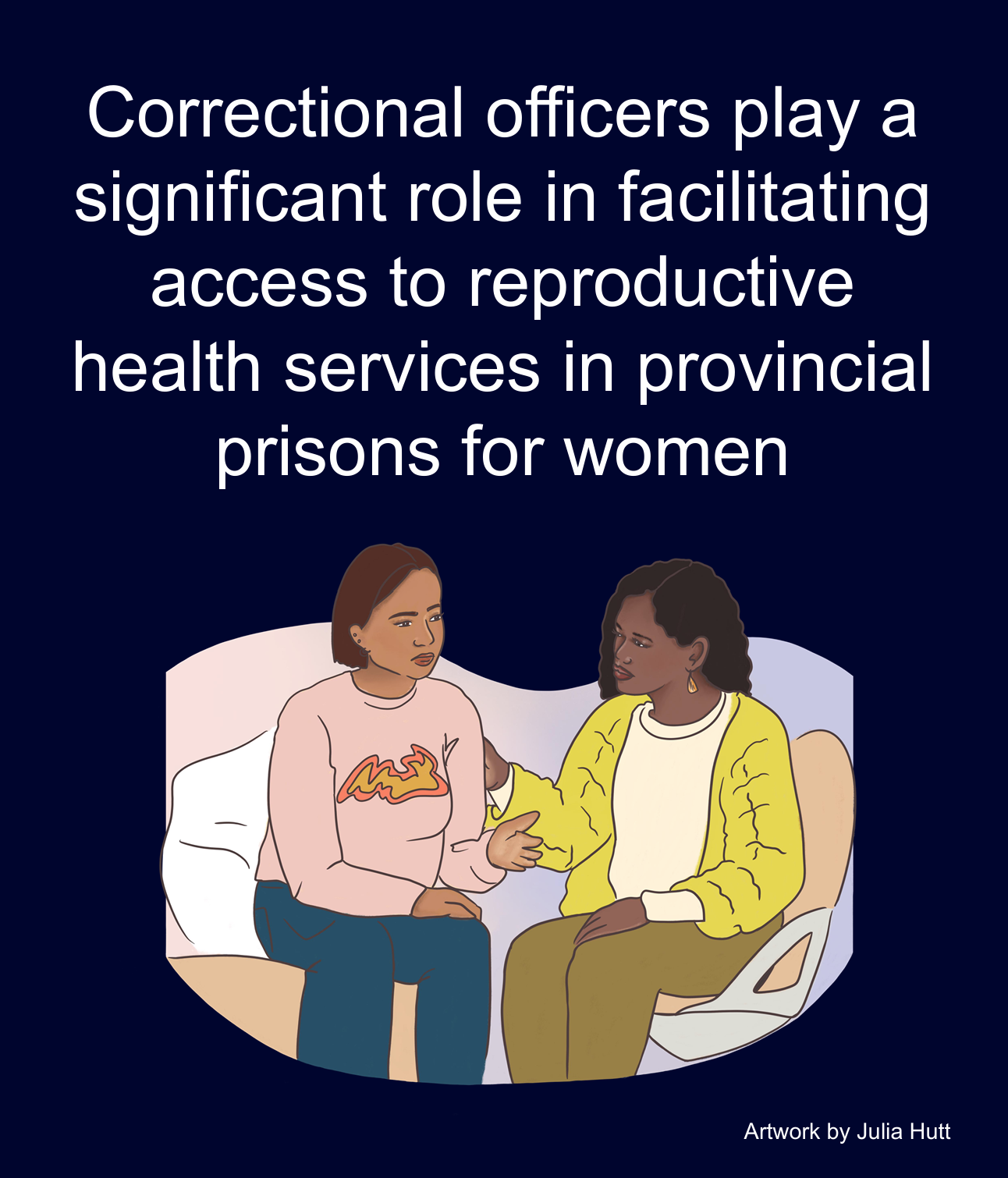 Learn more through our recent research poster
Ten Years of Changes to Maritime Abortion Incidence and Access
The Maritime provinces have long experienced unique barriers in access to abortion services. The potential impact of implementation of mifepristone for medication abortion has not yet been studied in terms of success in improving access. This study explores how abortion services have changed in the Maritimes since the implementation of mifepristone, providing a foundation to identify any ongoing regions, populations, and services with persistently poor access.
Funded by Canadian Institutes of Health Research Project GrantProvision and Access to Conjugal and Private Family Visits in Canadian Prisons
Evidence suggests that conjugal/private family visits (PFVs) can have a positive impact on the maintenance of family and personal relationships; despite this, there is very little research on the experience of conjugal visits in Canada. This project reviews policies governing the provision of and access to conjugal and/or PFVs in Canada, and works to understand the experience of accessing conjugal and/or PFVs from the perspective of incarcerated people and their families.
Funded by Canadian Bar Association Law for the Future FundCharter on the Sexual and Reproductive Rights of People in Prisons
More info coming soon!
Funded by Canadian Institutes of Health Research Catalyst FundDevelopment of a Theatrical Research-Based Performance: Mobilizing Findings from Research with Women and Gender Diverse People Experiencing Incarceration
More info coming soon!
Funded by Social Sciences and Humanities Research Council Connections GrantA Mixed Methods Study of Sexual and Reproductive Health in Prisons for Women in Colombia
More info coming soon!